


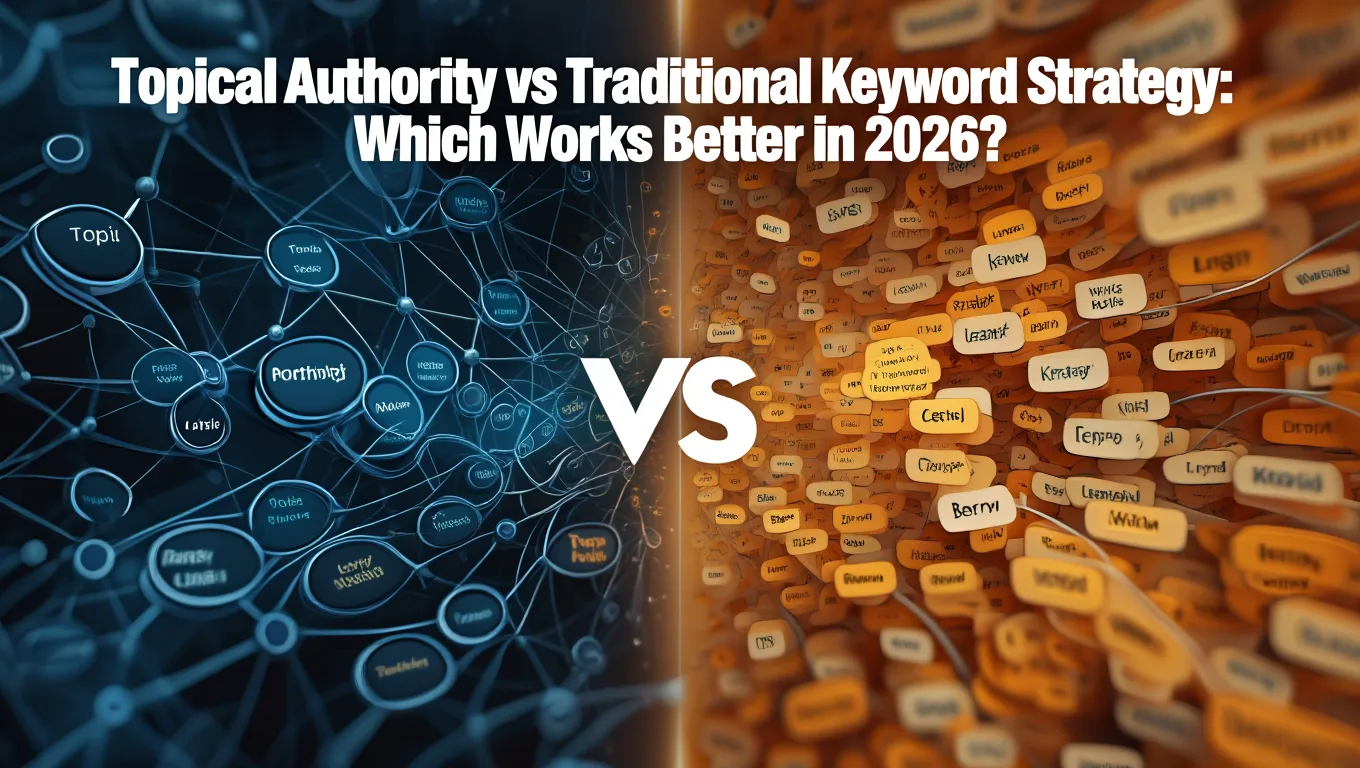

SEO strategy in 2026 has evolved significantly from five years ago. The debate between topical authority and traditional keyword strategy has moved from theoretical discussion to a genuine fork in the road for marketers, content teams and business owners deciding where to invest their resources.
According to Search Engine Land, search engines are increasingly rewarding sites that demonstrate deep subject-matter expertise over those simply targeting high-volume terms. Meanwhile, keywords haven’t disappeared entirely, but they’ve evolved.
Understanding the distinction between these two approaches is crucial, whether you’re building an organic content strategy or managing paid campaigns. The answer isn’t always one or the other. But before comparing them head-to-head, it’s worth understanding exactly what topical authority means and why it’s reshaping how Google evaluates content.
Understanding Topical Authority
Topical authority is Google’s assessment of how comprehensively a website covers a specific subject area. Rather than evaluating individual pages in isolation, search algorithms now analyze whether a site demonstrates deep, interconnected expertise across an entire topic ecosystem.
Where a traditional keyword strategy focuses on ranking individual pages for targeted search terms, topical authority treats a website as a unified knowledge resource.
In practice, this means search engines reward sites that cover a topic from multiple angles, addressing related subtopics, user questions and semantic variations rather than repeating the same keyword across thin pages. The underlying content becomes more valuable as a whole than any single article could be alone.
Understanding what topical authority is naturally leads to examining how it complements traditional strategies and why the older approach still holds relevance today.
Traditional Keyword Strategy Explained
Traditional keyword strategy focuses on identifying specific search terms your audience uses, then optimizing individual pages to rank for those terms. The formula has traditionally involved researching volume, assessing competition, matching search intent and building content around targeted phrases.
In practice, this approach treats each page as a discrete ranking opportunity. A site might target “best running shoes,” “affordable running shoes,” and “running shoes for beginners” as separate pages – each engineered around its own keyword cluster.
According to Keywords Everywhere, keywords remain a foundational signal, but their role has shifted considerably. Exact-match optimization alone rarely moves the needle anymore. Google’s understanding of semantic relationships means that stuffing a page with target phrases doesn’t guarantee rankings the way it once did.
Traditional keyword tactics typically include:
- Targeting high-volume, low-competition terms
- On-page optimization (title tags, headers, meta descriptions)
- Building individual landing pages per keyword cluster
- Tracking rank positions as the primary success metric
For teams using content optimization tools to scale production, keyword-led workflows still offer a clear, measurable structure. That predictability is precisely why many practitioners haven’t abandoned the approach entirely.
As any SEO strategies in 2026 discussion must acknowledge, traditional keyword research still provides valuable intent data, but the real question is whether targeting keywords in isolation is enough to compete. That answer depends heavily on how we evaluate both approaches against modern ranking criteria.
Criteria for Evaluating SEO Strategies in 2026
Before declaring a winner between topical authority and traditional keyword strategy, it’s worth establishing what “working better” actually means in today’s search environment. The goalposts have shifted considerably.
Effective SEO evaluation in 2026 hinges on several key criteria:
Sustained rankings
– Can the strategy maintain visibility through algorithm updates?
Search intent alignment
– Does the content satisfy what users genuinely need?
Scalability
– How well does the approach grow with your site?
Resource efficiency
– What investment is required relative to results?
Structuring content into content clusters is now a baseline expectation rather than an advanced tactic, which changes how both strategies should be measured. According to The New Keyword Rules for 2026, Google’s ranking signals increasingly reward contextual depth over isolated keyword matches, meaning a strategy’s ability to demonstrate subject-matter comprehensiveness carries real, measurable weight.
The most effective SEO strategies in 2026 are those that serve both search engines and human readers without compromise. Tactics optimized purely for crawlers lose ground quickly.
With these criteria clearly defined, comparing how each approach actually performs becomes far more straightforward and the results may surprise you.
Effectiveness: Topical Authority vs. Traditional Keyword Strategy
So which approach actually delivers results? The honest answer is that both strategies show measurable effectiveness, but in meaningfully different contexts.
Topical authority consistently demonstrates stronger long-term performance. Sites that build deep subject-matter coverage tend to earn trust signals that compound over time, ranking across broad keyword clusters rather than isolated terms. This matters significantly for AI search optimization, where language models and AI-powered search engines prioritize comprehensive, contextually rich sources when surfacing answers.
Traditional keyword strategy, however, remains highly effective for targeted, high-intent queries, particularly in competitive niches where precise optimization still drives conversions.
In practice, the gap between these approaches widens as content volume scales. A topical authority framework rewards sustained investment, while keyword-level optimization can produce faster initial wins with narrower reach.
The most resilient SEO strategies treat topical authority as the architecture and keywords as the building materials; neither works optimally without the other.
What complicates any direct comparison is how rapidly ranking signals shift. The criteria established in the previous section: traffic quality, content longevity and algorithm resilience – all point toward one critical question worth examining next: how well does each strategy adapt when Google changes the rules?
Adaptability to Algorithm Changes
Google’s core updates have increasingly rewarded semantic SEO – A signal that how search engines interpret content is fundamentally shifting. Sites structured around topical authority tend to absorb algorithm changes more gracefully. When ranking signals shift away from exact-match keywords toward entity relationships and contextual depth, a robust content cluster already aligns with those expectations.
Traditional keyword strategies, by contrast, can feel like chasing a moving target. A single core update can crater rankings built on thin, keyword-stuffed pages overnight.
Topical authority provides a buffer. Because it reflects genuine expertise across a subject area, it mirrors what Google’s quality raters consistently look for comprehensive coverage, clear authorship and trustworthy sourcing. Narrow keyword tactics offer no such structural resilience.
That adaptability advantage doesn’t mean topical authority is immune to change. Algorithm shifts can still affect how clusters are evaluated. But the underlying logic demonstrates expertise, answers questions thoroughly that has proven durable across multiple update cycles. The real question, then, is whether that durability also translates to long-term growth without proportionally growing effort.
Scalability and Future-Proofing
Scalability is where the two strategies diverge most sharply. Traditional keyword strategies tend to grow linearly more keywords mean more individual pages, each requiring its own research, optimization and maintenance cycle. Topical authority, by contrast, compounds over time. Comprehensive coverage of a subject area creates an interconnected content ecosystem where each new piece reinforces the ones before it.
What typically happens is that a well-structured topical cluster continues attracting traffic long after publication, because search engines recognize the site as a trusted subject-matter resource rather than a collection of loosely related documents. That distinction matters enormously when algorithm updates shift ranking signals.
Future-proofing also favors depth-first content strategies as AI-generated search overviews increasingly surface answers from sites demonstrating consistent expertise. A content library built around genuine authority is far harder to displace than isolated keyword-targeted pages.
With those dynamics in mind, a side-by-side breakdown can clarify exactly where each strategy holds its ground and where it doesn’t.
Comparison: Topical Authority vs. Traditional Keyword Strategy
The scalability and adaptability differences covered earlier become even clearer when laid side by side. Here’s how these two approaches stack up across the criteria that matter most in 2026:
| Factor | Topical Authority | Traditional Keyword Strategy |
|---|---|---|
| Core Focus | Subject-matter depth across a content ecosystem | Individual keyword targeting per page |
| Content Structure | Interconnected topic clusters | Standalone optimized pages |
| Algorithm Alignment | Strong – rewards semantic relevance | Weakening – vulnerable to core updates |
| Time to Results | Slower initial gains, stronger long-term ROI | Faster early wins, diminishing returns |
| Scalability | High – compounds over time | Linear – effort scales with output |
| Best For | Established or niche-focused sites | Campaign-driven or short-term goals |
Topical authority is a long-term infrastructure investment; traditional keyword targeting is a tactical tool. Neither is entirely obsolete, but the balance of power has clearly shifted. What’s worth questioning, however, is how much of current SEO practice still operates on assumptions that may no longer hold true.
Conventional Wisdom vs. Reality in 2026 SEO
The comparison table above tells a clear story, but numbers and checkboxes don’t always capture how dramatically SEO thinking has shifted. Much of what passed as best practice just a few years ago now actively works against sites trying to compete in an AI-influenced search landscape.
- The old assumption: Rank for the right keywords and traffic follows.
- The 2026 reality: Search engines reward demonstrated expertise across a subject domain. Understanding what is topical authority – the practice of building comprehensive, interlinked coverage around a core subject – is no longer optional background knowledge. It’s the operating principle behind modern rankings.
In practice, sites that obsessively chase isolated high-volume terms often find their content sandwiched between authority-heavy competitors they can’t displace. Meanwhile, leaner sites that methodically cover related subtopics, answer adjacent questions and build semantic depth tend to surface more consistently even for terms they never explicitly targeted.
Conventional wisdom also underestimated intent alignment. Google’s ability to interpret meaning over syntax has rendered thin, keyword-stuffed pages largely obsolete. What actually ranks today is content that satisfies the full arc of a user’s query journey – not just the entry point.
The shift isn’t purely theoretical, either. Tactical decisions from site architecture to internal linking, now carry meaningful SEO weight that keyword density never did. That said, no strategy is without trade-offs and topical authority building comes with its own set of real challenges worth examining carefully.
Limitations and Considerations
Neither strategy is without its trade-offs. Understanding where each approach breaks down is just as important as recognizing where it thrives.
Topical authority demands significant upfront investment. Knowing how to build topical authority is one thing; executing it consistently is another. It requires sustained content production, careful internal linking and subject-matter depth – resources that lean teams or early-stage sites may struggle to commit to. Results also take time, often months before measurable ranking gains appear.
Traditional keyword strategy, on the other hand, can feel more immediately actionable but increasingly runs into diminishing returns in competitive niches.
A few practical caveats worth noting:
- Niche volatility: topical authority built around a rapidly evolving subject can require constant updates to maintain relevance
- Over-specialization risk: going too deep into a narrow topic may limit organic traffic potential
- Tooling complexity: managing topic clusters and content mapping often requires structured SEO tooling or systematic workflows to avoid gaps
In practice, hybrid approaches tend to outperform either extreme. Keyword research still informs which subtopics to prioritize, while topical depth determines how well a site earns and retains authority signals over time.
With these limitations in mind, the clearest path forward becomes easier to define, which is exactly what the key takeaways ahead will outline.
Key Takeaways
The debate between topical authority and traditional keyword strategy ultimately resolves to a straightforward conclusion: they’re not opposites, but they’re partners. Keywords remain the navigational layer of SEO, but topical depth is what earns lasting trust from both search engines and readers.
In practice, the most effective approach in 2026 combines both. Build comprehensive coverage around core subjects first, then use keyword research to sharpen individual pieces. Tools like SEO-focused plugins can help streamline this balance at the execution level.
Chasing isolated keywords without topical context produces diminishing returns. But topical authority without keyword intent leaves traffic on the table. The question isn’t which strategy wins it’s how well you integrate them.
What SEO Strategies Are Working Really Well in 2026?
 Beyond the theoretical frameworks covered throughout this article, what’s actually gaining traction in practice? A consistent pattern emerges across industries: sites that blend deep topical coverage with deliberate keyword architecture are outperforming those committed to either approach alone.
In practice, the most effective playbook looks something like this:
- Build content clusters around a core topic before chasing individual keywords
- Map search intent at every stage of the funnel, not just transactional queries
- Refresh existing content to close topical gaps rather than always publishing new pages
- Pair organic strategy with paid signals includes testing keyword-level messaging through PPC accelerates what organic SEO takes months to validate
The site’s winning in 2026 treats authority and keywords as mutually reinforcing, not competing priorities. A strong keyword strategy without topical depth is just fishing with one hook; topical authority without keyword alignment is expertise nobody searches for.
What’s working for your site right now? The next section explores exactly that question – inviting a broader conversation about real-world results.
What SEO Strategy Is Actually Working for You Right Now?
The honest answer is: both, deployed intentionally. Practitioners seeing real traction in 2026 aren’t choosing between topical authority and keyword strategy, but they’re letting keywords surface the opportunities and letting topical depth win the rankings.
A common pattern is building tightly clustered content around a core topic, ensuring every supporting piece links back to a central pillar. Pair that with data-driven marketing strategies that connect SEO performance to actual business outcomes and the approach becomes measurably effective.
The strategy that consistently delivers: map keyword intent first, then build the content ecosystem around it. Keywords remain the compass; topical authority is the engine.
That raises a natural follow-up question – does the difficulty of a keyword still factor into this equation as meaningfully as it once did?
Does Keyword Difficulty Still Matter in 2026?
With so much focus on topical authority and semantic coverage, it’s fair to ask whether keyword difficulty (KD) still belongs in your planning toolkit. The short answer: yes, but with important caveats.
Keyword difficulty remains a useful signal but not a rigid gatekeeper. In practice, a site with deep topical authority can successfully target high-KD terms that would be unreachable for a generalist site with comparable domain metrics. Authority recontextualizes difficulty.
What’s shifted is how KD gets applied. Savvy practitioners now evaluate difficulty alongside topical fit – asking not just “how hard is this keyword?” but “does ranking here reinforce our authority cluster?” A strategically aligned high-KD keyword often outperforms an easy, off-topic term in the long run.
For teams building an optimized content strategy around a defined niche, KD works best as a sequencing tool: use lower-difficulty supporting content to establish topical signals first, then compete for high-value head terms from a position of earned authority.
Keyword difficulty remains relevant it has gained context. Which raises a bigger question worth examining: is topical authority itself delivering measurable results, or has it quietly become SEO’s newest buzzword?
Is Topical Authority Actually Working or Just Another SEO Trend?
The evidence points firmly toward working. Topical authority isn’t a fleeting tactic, but it reflects how modern search engines actually evaluate content quality and relevance.
The real answer to “topical authority vs. traditional keyword strategy” is deliberate integration. Topical authority determines whether Google trusts your site enough to surface it; keyword strategy ensures you’re targeting the right signals within that framework.
Topical authority complements keyword thinking; it’s the structure that enhances the impact of keyword strategies.
Start by auditing one core topic area. Build the cluster. Measure authority growth. That’s where 2026 SEO traction begins!